

In the Puerto Rican adventure, we consider icons those who left a significant mark in the identity and journey of not just our people, but the world. In their unique ways, they created new vistas for a young nation, under God, the Saints, and the universe, sailing across the stars to its own unique rhythm and flow.
This is not to say they were angels, of course. They were human, they had their flaws like everyone else in their time. But of the good in them, they focused a gracious amount of fabric to the tapestry of our nation. But the imprint of these figures are not bound to our community alone. They are icons because they transcended their boundaries of spacetime, and continue to inspire generations of athletes, engineers, educators, astronauts, and entertainers around the world. They are icons because they continue to shape our island’s destiny, our diaspora, and the future of the human experience.
Somos más
(Current Featured Icons)

Jean-Michel Basquiat (1960-1988) was a visionary American artist of Haitian and Puerto Rican descent who rose from New York City’s graffiti scene to become a central figure in the neo-expressionist movement of the 1980s. Born in Brooklyn, the artist grew up speaking Spanish, French, and English. His father was Haitian, but it was his Puerto Rican mother’s profound cultural knowledge and unwavering support that nurtured his passion for art and culture. Basquiat’s groundbreaking work critiqued power structures, celebrated Black identity, and explored themes of wealth, poverty, and racial segregation. Basquiat’s distinctive style, characterized by raw, gestural brushstrokes, expressive figures, and cryptic symbols, rapidly propelled him to international fame, with his art being exhibited in prestigious galleries worldwide and collaborating with Andy Warhol. Despite his tragically short life, Basquiat left an indelible mark on contemporary art, challenging conventions and creating a powerful visual language that continues to resonate globally. His art remains a potent voice for social commentary and artistic freedom. Before his rise to art stardom, Basquiat was also part of a noise rock band called Gray, performing in downtown Manhattan clubs. He even produced a track for a rap record during this period, showcasing his diverse creative interests beyond painting. But it would be his visual renditions that would immortalize him. In 2017, Untitled, a skull painting he made in 1982, sold at Sotheby’s for $110.5 million, becoming the most expensive artwork by an American artist ever sold at the time.
Chita Rivera (born Dolores Conchita Figueroa del Rivero, 1933–2024) was a legendary American dancer, singer, and actress of Puerto Rican descent whose electrifying stage presence and unparalleled talent defined Broadway for over six decades. Born in Washington, D.C., she captivated audiences with her powerful vocals, dynamic choreography, and magnetic charm in iconic roles such as Anita in West Side Story (Chita Rivera originated the role of Anita on Broadway in 1957, directed and choreographed by Jerome Robbins, while Rita Moreno played Anita in the 1961 film adaptation directed by Robert Wise and Jerome Robbins), Velma Kelly in Chicago, and the title role in Kiss of the Spider Woman. A recipient of the Presidential Medal of Freedom and a three-time Tony Award winner (with 10 nominations), Rivera shattered racial barriers and redefined the possibilities for Latina performers on stage. Her fierce dedication to her craft and her trailblazing career cemented her status as one of Broadway’s most enduring and influential stars, inspiring generations of performers. Chita Rivera originally wanted to be a ballerina, training at the School of American Ballet on scholarship. It was only after accompanying a friend to an audition that she landed her first Broadway role in Call Me Madam, pivoting her career from classical ballet to musical theater.
Antonia Pantoja (1922–2002) Antonia Pantoja was a visionary Puerto Rican educator, activist, and civil rights leader who dedicated her life to empowering the Puerto Rican community in the United States. Born in San Juan, Puerto Rico, she moved to New York City and became a driving force behind numerous groundbreaking institutions. Most notably, she founded ASPIRA in 1961, an organization dedicated to fostering educational and leadership development among Latino youth, which became a national model. Pantoja also co-founded Boricua College and the Puerto Rican Forum, championing bilingual education, cultural preservation, and economic self-sufficiency. A recipient of the Presidential Medal of Freedom, her relentless advocacy for social justice and educational equity transformed opportunities for countless individuals and cemented her legacy as a formidable force in the civil rights movement. Antonia Pantoja initially wanted to be a nun but was rejected due to her “rebellious nature.” This early experience, though a setback for her religious aspirations, foreshadowed her lifelong commitment to challenging authority and fighting for justice through activism.
Pura Belpré (1899–1982) was a pioneering Puerto Rican librarian, author, and storyteller who became the first Puerto Rican librarian in the New York Public Library system. Hired in 1921, she dedicated her career to promoting Puerto Rican culture and bilingual education, introducing Spanish-language story hours and incorporating Puerto Rican folklore into library programs. Belpré wrote and translated numerous children’s books, such as Perez and Martina, preserving Puerto Rican oral traditions and making them accessible to Latino children in the U.S. Her work laid the foundation for multicultural children’s literature and library services for Spanish-speaking communities. Belpré was also a puppeteer, crafting puppets to bring her stories to life during library programs, a skill she learned to engage young audiences.
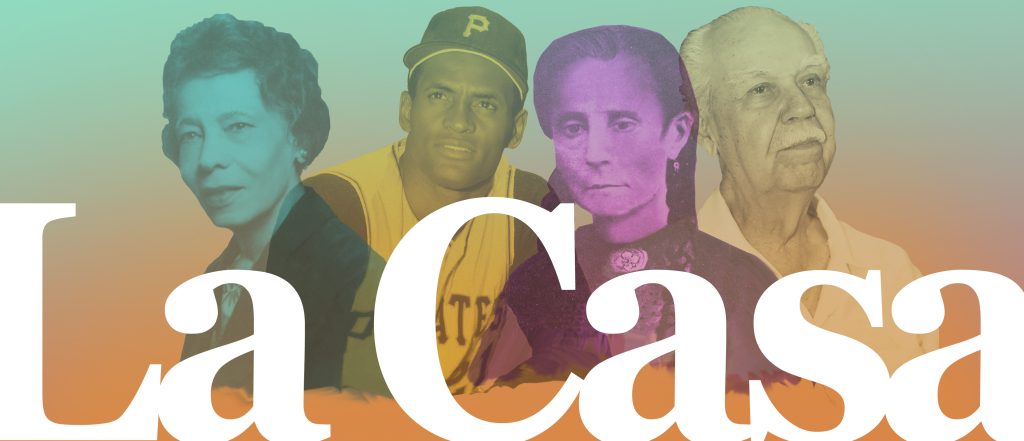
Roberto Clemente (1934–1972) was a legendary Puerto Rican baseball player and humanitarian, widely regarded as one of the greatest right fielders in Major League Baseball history. Playing for the Pittsburgh Pirates from 1955 to 1972, he achieved 3,000 hits, won 12 Gold Gloves, and led the Pirates to two World Series titles, earning the 1971 World Series MVP. Off the field, Clemente was a passionate advocate for social justice, using his platform to combat racial discrimination and support Puerto Rican and Latin American communities. His tragic death in a plane crash while delivering aid to earthquake victims in Nicaragua cemented his legacy as a hero. Clemente was an accomplished musician who played the organ and harmonica, often entertaining teammates with impromptu performances.
Mariana Bracetti (1825–1903), known as the “Brazo de Oro” (Golden Arm) for her sewing skills, was a Puerto Rican revolutionary and key figure in the 1868 Grito de Lares, Puerto Rico’s first major revolt against Spanish colonial rule. As a leader in the Lares Revolutionary Council, she sewed the first Puerto Rican flag, the “Bandera de Lares,” which became a symbol of independence. Bracetti’s courage and organizational efforts inspired the fight for Puerto Rican sovereignty and women’s involvement in political activism. Her legacy endures as a symbol of resistance and national pride. Bracetti was imprisoned after the revolt but continued her activism quietly, reportedly teaching other women to sew as a form of economic empowerment while in exile.
Ricardo Alegría (1921–2011) was a Puerto Rican anthropologist, archaeologist, and historian who profoundly shaped the preservation of Puerto Rican culture. As the founder of the Institute of Puerto Rican Culture (1955) and the Center for Advanced Studies on Puerto Rico and the Caribbean, he championed the study and celebration of Puerto Rico’s African, Taíno, and Spanish heritage. Alegría’s efforts led to the restoration of historic sites like Old San Juan and the establishment of cultural institutions, ensuring Puerto Rican identity was preserved amid rapid modernization. Alegría was an avid collector of Puerto Rican santos (wooden religious carvings), amassing a personal collection that he later donated to museums to promote traditional folk art.

Modesto Cartagena (1921–2010), a Puerto Rican soldier, earned the distinction of being the most decorated Latino soldier in U.S. military history for his heroic actions during the Korean War as a member of the 65th Infantry Regiment, known as the “Borinqueneers.” Serving as a Sergeant First Class, he displayed extraordinary bravery in 1951 during the Battle of Yonchon, where he repeatedly exposed himself to enemy fire to protect his unit, earning the Distinguished Service Cross, two Silver Stars, two Bronze Stars, and multiple Purple Hearts, among other honors. His courage helped elevate the recognition of Puerto Rican soldiers’ contributions to the U.S. military, and he is a candidate for the Congressional Medal of Honor. Cartagena’s legacy underscores the valor and sacrifice of Puerto Rican servicemen. Cartagena, a humble man, worked as a security guard after retiring from the military and rarely spoke of his decorations, preferring to let his actions speak for themselves.
Luisa Capetillo (1879–1922) was a pioneering Puerto Rican labor organizer, feminist, and anarchist who championed workers’ and women’s rights in the early 20th century. Born in Arecibo, she worked as a lectora (reader) in tobacco factories, where she became a leader in the Federación Libre de Trabajadores, organizing strikes and advocating for fair wages and women’s suffrage across Puerto Rico, Cuba, and the U.S. Her essays, published in Mi Opinión, boldly critiqued labor conditions and patriarchal norms, and she is famously remembered as the first woman in Puerto Rico to wear pants in public, challenging societal norms. Capetillo’s work laid critical groundwork for labor and feminist movements in the Caribbean. Capetillo wrote a play, “Influencias de las Ideas Modernas”, inspired by Tolstoy, featuring a character reflecting her own anarchist ideals, which was performed in workers’ circles.
Evelina López Antonetty (1922–1984) was a Puerto Rican community activist and educator who founded United Bronx Parents in 1965, a transformative organization dedicated to improving education and social services for Latino and African American communities in the South Bronx. Her advocacy focused on bilingual education, parental involvement, and combating systemic inequalities in schools, leading to significant reforms in New York City’s education system. Known as “Hell Lady of the Bronx,” she empowered parents to demand better resources and opportunities for their children, leaving a lasting impact on community organizing and educational equity. Antonetty’s early activism included organizing Puerto Rican women in garment factories, a precursor to her later work in education, reflecting her lifelong commitment to labor justice.
Ismael Rivera (1931–1987), known as “El Sonero Mayor” and “Maelo,” was an Afro-Puerto Rican salsa singer and composer whose soulful voice and improvisational soneo style made him a foundational figure in salsa music. Born in Santurce, Puerto Rico, Rivera rose to fame with Cortijo y su Combo, blending Afro-Puerto Rican bomba and plena with Cuban rhythms, and became the first Black Puerto Rican singer to perform on national television, breaking racial barriers. His songs, like “El negro bembón,” addressed racism and social issues, resonating with communities across Latin America and New York. Rivera’s legacy as a cultural icon endures through his music and advocacy for Afro-Puerto Rican identity. Rivera’s nickname “Maelo” came from his childhood mispronunciation of his name, a quirky trait his fans embraced as part of his charm.

Pedro Albizu Campos (1891–1965) was a Puerto Rican attorney, nationalist leader, and president of the Puerto Rican Nationalist Party, who became a towering figure in the movement for Puerto Rican independence from U.S. colonial rule. Born in Ponce, Puerto Rico, he was the first Puerto Rican to graduate from Harvard Law School, where he excelled despite facing racial discrimination. Returning to Puerto Rico, Albizu led the Nationalist Party in the 1930s, advocating for sovereignty through speeches and organizing resistance, including the 1950 Jayuya Uprising. His activism led to multiple imprisonments, totaling over 25 years, and he endured harsh treatment, including alleged radiation experiments while incarcerated. Albizu’s unwavering commitment inspired generations of Puerto Ricans to embrace their cultural identity and demand self-determination. Albizu was a polyglot who spoke English, Spanish, French, German, Portuguese, and Italian fluently, plus he was well versed in the two classic languages of Latin, and ancient Greek. He used his linguistic dexterity to study global revolutionary movements and refine his nationalist ideology. As president of the Harvard Cosmopolitan Club, Albizu welcomed Éamon de Valera in Boston and delivered a notable speech in support of Irish independence, described as “the speech of the evening” at a Harvard event.
Julia de Burgos (1914–1953) was a celebrated Puerto Rican poet, feminist, and advocate for social justice, whose lyrical works explored themes of love, identity, feminism, and Puerto Rican independence. Born in Carolina, Puerto Rico, she published her first poetry collection, Poema en veinte surcos (1938), which gained widespread acclaim for its passionate and vivid imagery. As a member of the Puerto Rican Nationalist Party, she used her poetry and journalism to champion independence and critique colonialism, racism, and gender inequality. Despite personal struggles with poverty and alcoholism, her works, like “Río Grande de Loíza,” remain iconic in Latin American literature, cementing her as one of Puerto Rico’s greatest literary voices. De Burgos was an avid painter in her youth, creating vibrant watercolors inspired by Puerto Rico’s landscapes, though she destroyed most of her artwork, believing it distracted from her poetry.
Lolita Lebrón (1919–2010) was a Puerto Rican nationalist and revolutionary who became a symbol of resistance for leading the 1954 attack on the U.S. House of Representatives to protest U.S. colonial rule over Puerto Rico. Born in Lares, Puerto Rico, she joined the Puerto Rican Nationalist Party under Pedro Albizu Campos and moved to New York City, where she witnessed the struggles of Puerto Rican migrants. On March 1, 1954, Lebrón and three other nationalists opened fire in the U.S. Capitol, unfurling a Puerto Rican flag and shouting “¡Viva Puerto Rico Libre!” to demand independence. Sentenced to 50 years in prison, she was pardoned in 1979 and continued advocating for Puerto Rican sovereignty and social justice. Her bold act galvanized the independence movement. Lebrón was a skilled seamstress who designed and sewed her own dresses, including the one she wore during the Capitol attack, which she chose to reflect Puerto Rican pride.
Ramón Emeterio Betances (1827–1898), known as “El Padre de la Patria” (Father of the Homeland), was a Puerto Rican physician, abolitionist, and revolutionary who led the 1868 Grito de Lares, Puerto Rico’s first major uprising against Spanish colonial rule. Born in Cabo Rojo, Puerto Rico, he studied medicine in Paris, where he embraced liberal ideals, and returned to advocate for the abolition of slavery and Puerto Rican independence. Betances organized secret revolutionary cells, co-designed the Puerto Rican flag with Mariana Bracetti, and inspired the Lares revolt, celebrated today as the official birthday of Puerto Rican national identity. Exiled to France, he continued writing and supporting Caribbean independence movements, including an economic and military confederation of the Greater Antilles. Betances was an accomplished chess player who used the game to strategize revolutionary tactics, often comparing political moves to a chessboard in his correspondence with allies.